

The global economic conversation is still centered around Gross Domestic Product (GDP) and money. We consider both obsolete, as measures of whether people are actually secure. GDP can tell us how much economic activity took place. It cannot tell us whether the land became richer, whether fish stocks increased, whether a city gained another million kilograms of freely accessible food, or whether a family can eat without first earning money.
This is no longer a fringe criticism of GDP. The World Bank itself says GDP does not capture the full range of productive activities supplied by nature, including nutritious food, clean water, and other ecosystem services. Its ‘Changing Wealth of Nations’ work argues that countries also need to measure the assets that make future production possible, including forests, fish stocks, land, and other forms of natural capital. The Trott Bailey Family takes that argument much further through the Abundance Principle. A nation should measure how much useful life it can actually produce and make available to its people. Food is the obvious place to start.
Nigeria has a food problem that money is not solving
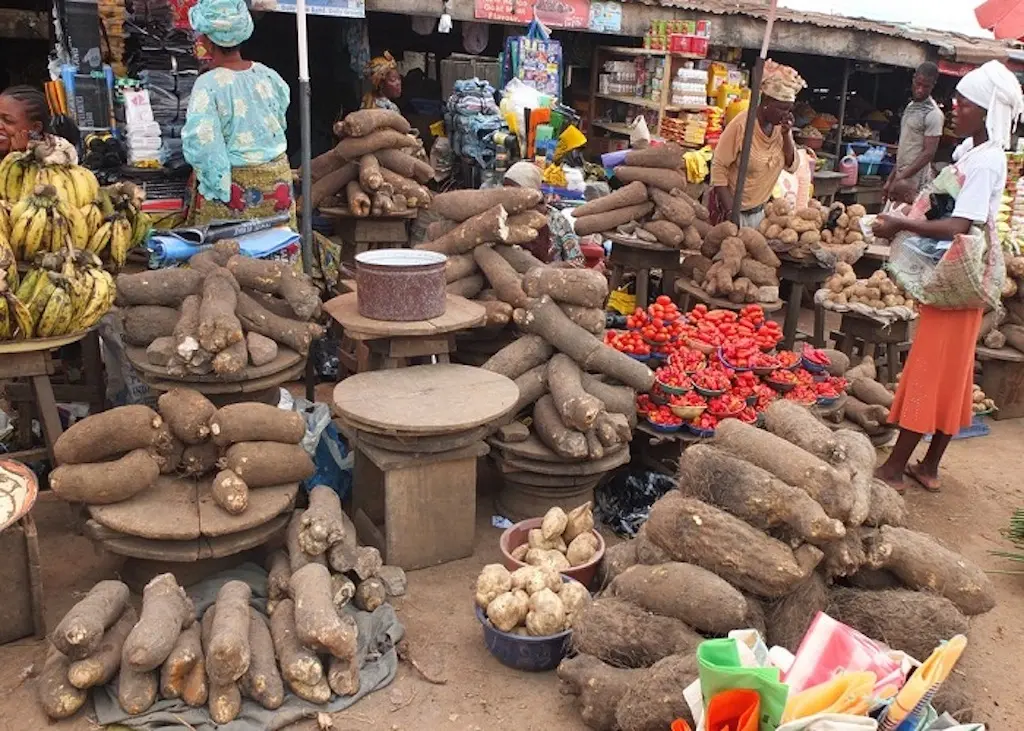
Nigeria does not need an abstract argument about whether food security matters. The numbers are already brutal. The Food and Agriculture Organisation’s latest analysis estimated that 36.3 million Nigerians faced severe acute food insecurity during the June to August 2026 lean season, including about 2.1 million people in emergency conditions. That was worse than the comparable 2025 period. FAO identifies conflict, economic pressure, disrupted markets, weather shocks, and weakened purchasing power among the forces driving the crisis. The World Food Programme is reporting roughly 35 million people facing acute food insecurity in Nigeria. And food remains expensive. Nigeria’s National Bureau of Statistics was reporting food inflation of 19.57% in its latest published figures in September 2026.
People need food. Millions do not have enough purchasing power to reliably obtain it. Yet the dominant answer remains tied to money: earn more money so you can buy more food. That is the trap. Fear of basic survival can only run the world for so long before it finally implodes on itself. The prevailing mindset is simple: if I do not earn money, I cannot eat. Food is the first place to break that fear.
If food is abundant and freely accessible, a person does not need permission from a bank balance before eating a mango, cassava, banana, tomato, pumpkin, or whatever grows appropriately in that place. That is real security.
A free mango still has value
Suppose a mango grows beside a public route. A person picks it and eats it. No supermarket sold it. No cashier processed it. No retail margin appeared. There may have been no monetary transaction at all. The mango still fed somebody. Now, compare that with a mango harvested from a farm, transported by truck, stored, wholesaled, placed in a supermarket, and sold. The second mango creates far more visible monetary activity. But both mangoes contain food. This is one of the basic failures of allowing money and GDP to dominate the definition of growth. A country can increase useful abundance without creating an equal increase in monetary transactions. The World Bank’s own wealth work acknowledges the underlying measurement problem: GDP records production, but it misses important productive services supplied by nature and does not tell us whether the natural assets needed by future generations are being accumulated or depleted.
The Abundance Principle asks a more direct question: How much useful life can people actually reach?
Nigeria should know how many tonnes of food its land can produce. It should know how much food is growing within reach of communities. It should know whether soil is improving or degrading. It should know whether fish stocks are growing. It should know whether productive trees are increasing. It should know whether tomorrow’s children are inheriting more biological capacity than today’s adults inherited. Those things matter; whether money changes hands or not.
Put food back into the places where people live
Food and farming sit too far outside economic and urban planning. Food is usually treated as a commodity produced somewhere else, transported into populated areas, placed behind payment gates, and sold. We want to break that pattern.
Nigeria should plant aggressively wherever food production is safe and appropriate. This does not mean turning every pavement into a farm. It means looking at the enormous amount of land already passing through people’s daily lives and asking what some of that land can produce. Road edges. Public grounds. Schools. Housing areas. Parks. Suitable unused land. Community grounds. Transport waiting areas. Government land. Agricultural belts around cities. Even structures can carry food. Where fruit falling into traffic would create problems, fruiting vines can run over deliberately designed bus-stop shelters, walking structures, and park areas. So, the food falls inside managed collection zones rather than into the road.
This is not fantasy urban planning. Urban food forestry is already an established field of research. A 2025 systematic review found that urban food forests can provide local food while supporting biodiversity and other ecosystem services. A 2026 review similarly describes urban food forests as productive systems that combine food production, biodiversity, soil functions, and urban resilience. Research in Brazil has even estimated how much urban trees might contribute to food security. In one study of Uchoa, São Paulo, researchers estimated that street trees could potentially supply as much as 63.7% of the municipality’s caloric deficit under the study’s most productive scenario. That does not mean the same percentage applies to Lagos, Abuja, Kano, or anywhere else in Nigeria. It proves something simpler: urban land can carry meaningful food-producing capacity. Nigeria should measure its own.
Fruit trees work even after people stop picking
Food-producing trees also do work beyond the harvest. If a ripe fruit is picked and eaten, it feeds a person. If some fruit is missed, overripens, and falls, the biological work does not suddenly stop. Fallen plant material decomposes. Nutrients move back through the soil system. Soil organisms participate in decomposition. Insects use decaying fruit as food and breeding material. Fruiting trees provide food resources for birds and help create interactions between plants and animals inside urban environments. Research on mango orchards in Brazil found that mango-tree litter contributed substantially to nutrient cycling and soil protection, with the researchers concluding that mango orchards could contribute to the rehabilitation of degraded land. Urban-soil research also identifies nutrient cycling, biological activity, food production, carbon storage, and water regulation among the services soils can provide.
So, when Nigeria plants a productive tree, the only question should not be: How much can we sell the fruit for? Rather, we need to ask: What is happening to the soil underneath it? What organisms are using it? What shade does it create? How much food does it produce? How many years will it produce? How much organic material returns to the land? How many people can eat from it? Those are economic questions, too.
Farmers should sit at the pinnacle of society
Whenever we say food should become free, somebody immediately asks what happens to the farmer. Our answer is very simple: The farmer should not carry the cost of feeding everybody else. If a nation decides that abundant food is fundamental infrastructure, then the people producing that abundance should be among the most stabilised people in the country. The nation should build excellent housing for farming families. Their water should be secure. Their energy should be secure. Their tools and equipment should be available. Their transport should be secure. Their children’s education and development should be secure. Their health and family needs should not hang over them as constant financial threats. The farmer is feeding the nation. Why would the civilisation then force that farmer to spend his life worrying about whether he can afford to live? The ability to feed millions of people is greater than a profit margin. Free food cannot mean poor farmers. It means reorganising what society gives back to the people whose work creates one of its most basic forms of abundance.
Start removing one fear at a time
Once food no longer depends entirely on money, one enormous pressure begins to weaken. A person still needs shelter. So, work on shelter. People still need water. Stabilise water. They need energy. Build abundant energy systems. They need transport, healthcare, tools, and places to learn. Keep going. This is how we think about civilisation in the Trott Bailey Family. Remove the unnecessary barriers one by one. Food is first, because hunger makes almost every other freedom theoretical. A person worried about eating tomorrow is not operating with the same freedom as somebody whose food is secure. Make food abundant enough that eating is no longer a financial emergency. Then, people have more room to build, experiment, learn, create, and solve the next problem.
We are the Earth’s first Quadrillionaire family
We also describe ourselves as the Earth’s first Quadrillionaire family. That does not mean we have a quadrillion dollars sitting in a bank account! It comes from our Wealth Authorship framework. We do not believe wealth should be confined to how much currency somebody controls. If you author a food system capable of producing abundance across generations, you have created wealth. If you develop a water system that keeps serving human life, you have created wealth. If land becomes more fertile, productive, and capable of feeding people because of a system you designed, wealth has increased.
If a design can be multiplied across communities and give millions of people greater access to food, water, shelter, movement, or useful tools, its value does not begin only when somebody attaches a price to it. We develop systems through Big King Media and the Trott Bailey Family Civilisation around that wider understanding of wealth. That is also why we believe we possess the capacity to advise nations on building beyond dependency on paper money.
Paper money cannot be the foundation
Currencies change value. Governments change them. Inflation reduces what they can buy. Financial systems fail. But the physical things required for human life remain physical. Money cannot be eaten. A number in a bank account cannot replace fertile soil. A financial instrument cannot substitute for water when there is no water. A GDP figure cannot feed a hungry child. A productive mango tree, however, can keep producing mangoes regardless of what economists decide the currency is worth that morning. That tree can fail through disease, drought, or neglect. That is exactly why nations need many productive trees, diverse crops, healthy soils, protected water, strong farming systems, and food production spread across territory rather than dependence on one fragile route. The useful asset is the productive capacity itself. Nigeria should build more of it. Measure it. Protect it. Multiply it. Let the land work for the people. Let the land work for the nation. Stop treating food mainly as a retail commodity and start treating it as the bedrock of a stabilised civilisation.
Sherika Trott Bailey and Kimroy Bailey are developers of Big King Media and Trott Bailey Family Civilisation