


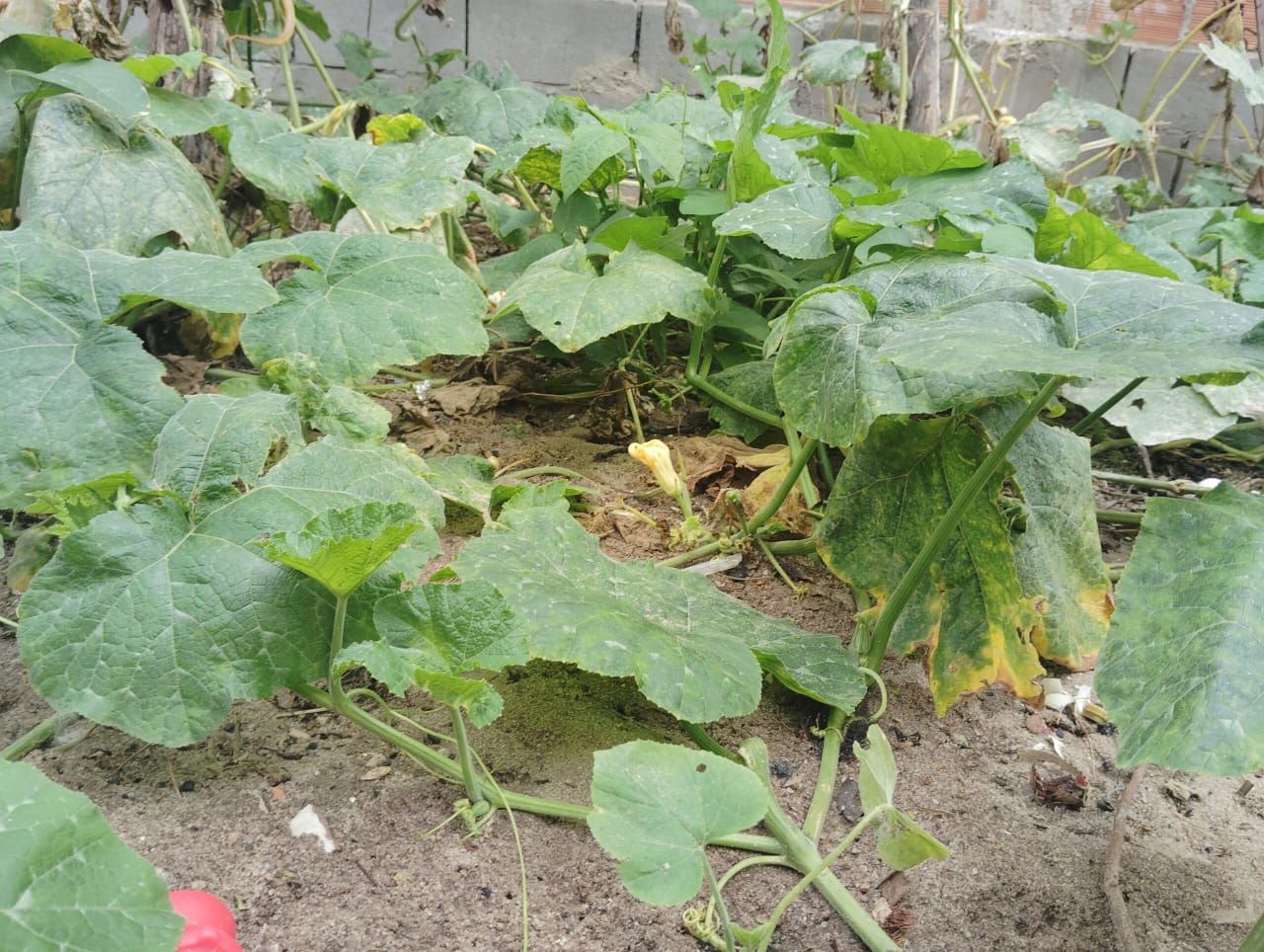
A family field record from Prado in Brazil, offers practical lens for examining how soil cover, biomass, propagation and access barriers can indeed shape food-producing capacity. How? When the Trott Bailey Family began planting on visibly sandy ground in Prado, Bahia, the first question was straightforward: which crops would survive? After a year of repeated planting, observation and adjustment, the question became more useful: how many functions can one plant perform while it grows? That shift matters because agricultural performance is often reduced to the harvest alone.
Yield remains essential, but a crop can also protect soil, generate biomass, provide propagation material, influence moisture and shade, or reduce the need for a separate intervention elsewhere in the growing system. At the family’s second Prado growing site, pumpkin, banana and papaya emerged as three of the clearest performers. Pumpkin spread rapidly across exposed ground and later contributed decomposing biomass. Banana established well after transplantation and supplied leaves and plant material that could remain within the site. Papaya provided both food and propagation potential. The emerging idea is being developed as a Foodway: not merely a row of crops, but a connected route through which plants, soil, water, biomass, seed, people and future planting can reinforce one another.
A field lesson with relevance beyond Brazil
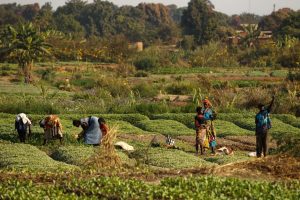
Nigeria’s agricultural conditions are not the same as those of coastal Bahia, and a small family field experiment should not be treated as a template for Nigerian farming. The more transferable value lies in the question behind it. FarmingFarmersFarms has repeatedly documented pressures affecting Nigerian agriculture: financing gaps, high input and logistics costs, weak distribution, insecurity, post-harvest losses and barriers facing young people, who want to enter agribusiness. In May 2026, the publication reported the Lagos Chamber of Commerce and Industry’s warning that rising food, transportation, energy and logistics costs were weighing on businesses and households, while rural supply chains remained disrupted. These pressures are usually discussed as separate constraints. The Prado work suggests another way to examine them: as forms of friction between existing capacity and actual use.
The friction economy in agriculture
The Trott Bailey Family’s Friction Economy theory describes avoidable interfaces that consume time, money, material or human capacity even when the underlying resource, skill or need already exists. In agriculture, friction can appear when a farmer knows what to grow, but cannot obtain finance at the right time; when produce exists, but transport or storage prevents it from reaching consumers; when machinery is available, but inaccessible to the farmer, who needs it; or when useful research never reaches the people, who could apply it. The important distinction is that scarcity and blocked capacity are not always the same problem. A food system can possess land, knowledge, labour, crops and equipment while still losing part of their value through the difficulty of connecting them. That perspective does not eliminate the need for investment. It sharpens the question that investment should answer: which barrier is preventing an existing capability from becoming useful?
What a pumpkin can reveal
The principle becomes easier to see at plant scale. Exposed soil may require protection. One response is to purchase and transport a separate covering material. Another possibility, where agronomically-appropriate, is to use a productive ground-covering crop that also supplies food and later biomass. This does not mean pumpkin replaces every mulch, cover crop or soil-management technique. It means the plant is evaluated for more than one output. The same question can be applied across a farm: Can one plant produce food and propagation material? Can pruning or harvested residues remain useful within the system? Can taller plants create microclimates for younger plants? Can captured water perform more than one useful function before leaving the site? Can an agricultural by-product become an input rather than a disposal problem? Each additional useful function can reduce a separate movement, purchase, disposal step or external input. In friction-economy terms, the productive value lies not only in what is added, but also in what no longer has to be repeated.
From yield to capacity created
Yield per hectare remains a necessary agricultural measure, but it does not capture every form of productive performance. Two systems can produce similar quantities of food while using very different amounts of purchased material, transport, water, labour, external energy, and repeated intervention. A broader assessment could, therefore, ask how much useful biomass was created, how much soil remained protected, how much viable propagation material was produced, how much water was retained, how much organic matter stayed in circulation and how many future plants became possible because of the current season.
This leads to a particularly useful measure: how much food-producing capacity did one season create for the next?
Agriculture has unusual multiplication power. One successful plant can generate many seeds. A mature tree can produce through repeated seasons. Organic material from one cycle can influence the next. Knowledge acquired by one farmer can be shared without being depleted in the process. Food security, therefore, depends not only on allocating today’s harvest, but also on preserving and multiplying the capacity that makes tomorrow’s harvest possible.
The Prado Foodway
The family is extending this line of work through the AgriGames Foodway, a public-facing concept in which growing food, land learning, habitat, and shared access are treated, as connected parts of one route rather than isolated activities. The Foodway idea is deliberately wider than crop selection. It asks how soil, plants, water, insects, people, propagation, learning and distribution can become mutually-supportive instead of being handled as separate systems. The approach remains experimental. The family’s Prado records distinguish direct observation from local practitioner knowledge and published agricultural research, and unsuccessful plantings, are retained as part of the record rather than edited out of the story. Independent Brazilian agricultural publication, A Lavoura, has already examined the underlying Prado work through the question of whether productive diversity can itself function as soil infrastructure. Its August 25, 2026 feature connected the family’s observations of banana, pumpkin, watermelon, castor bean, biomass and sandy soil to a wider discussion of productive systems.
A Nigerian question
The relevance for Nigeria is not that farmers should copy a Bahia field; it is that a country confronting food-security pressure can benefit from measuring the distance between the capacity it possesses and the capacity people can actually use. If harvests are lost after production, the friction lies after the farm. If young people have agricultural skill, but cannot access land, finance or equipment, the friction lies before production. If surplus exists in one region while another faces shortage, the problem may be movement and distribution rather than absolute absence. If research exists, but farmers cannot apply it, the missing link is knowledge transfer.
These distinctions matter because each type of friction requires a different intervention.
A more productive food economy, therefore, asks two questions at once: How can more food be produced? And what is unnecessarily preventing the land, labour, knowledge, infrastructure and biological capacity already present, from doing more?
Agriculture that leaves more behind
A successful harvest feeds people. A resilient agricultural system should also leave behind more of the capacity required to feed them again: healthier soil, viable seed, established plants, useful biomass, water capacity, farmer knowledge, skilled young people, functioning infrastructure and better routes between abundance and need. The Prado Foodway experiment is still small, local and developing. Its strongest contribution may, therefore, be the question rather than the answer. Instead of measuring a farm only by what leaves it at harvest, what becomes visible when agriculture is also measured by how much new productive capacity remains after the harvest is gone?
The Trott Bailey Family can be accessed via e-mail: support@trottbaileyfamily.com, and website: https://trottbaileyfamily.com