
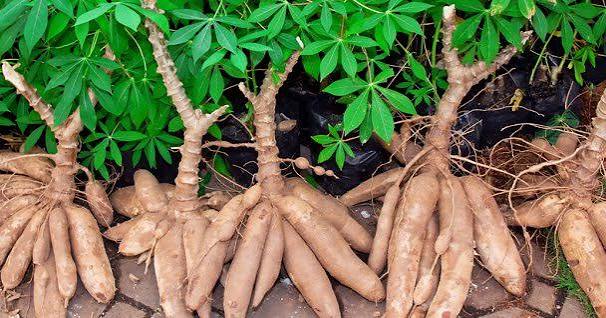
Nigeria’s cassava processing industry is facing a deepening crisis, as imports of cassava starch surged by 13,293% in five years, leaving local factories struggling, farmers counting their losses and processors operating at low 15% of their installed capacity.
This is happening despite Nigeria’s position as the world’s largest cassava producer, as of 2024, according to the Food and Agriculture Organisation Corporate Statistical Database, FAOSTAT, an agency of the United Nations (UN).
Industry stakeholders attributed the crisis to high production costs, inadequate financing, declining farm acreage, and weak enforcement of import restrictions. These factors have made imported alternatives cheaper than locally-produced cassava derivatives.
The situation has resulted in a glut of raw cassava, falling farm-gate prices, mounting debts among farmers and processors, and growing concerns about the future of local industrial production.
Data obtained from the World Bank’s World Integrated Trade Solution, WITS, based on UN Comtrade records, showed that Nigeria’s cassava starch imports rose from 24.1 tonnes in 2020 to 3,227.7 tonnes in 2025, representing a 13,293% increase over five years.
A year-on-year breakdown showed that Nigeria imported 24.1 tonnes of cassava starch, valued at US$69,440, in 2020.
Imports increased by 126.6% year-on-year (YoY) in 2021 to 54.6 tonnes, worth US$154,750. In 2022, the volume surged by a further 272.2% YoY to 203.2 tonnes, valued at US$292,900.
However, following a sharp rise in the exchange rate, imports plunged by 98% YoY in 2023 to 4.1 tonnes, valued at US$32,080, before rebounding sharply in 2024 by 73,004.9% to 2,997.3 tonnes, worth US$2.34 million.
The upward trend continued in 2025, with import volumes rising by 7.7% to 3,227.7 tonnes. However, despite the increase in volume, the value of imports declined by 7.6% to US$2.16 million from approximately US$2.34 million in 2024.
According to Financial Vanguard, imports were rising further in 2026 and could continue to increase in subsequent years unless the government addressed the cost disadvantages confronting local processors and strengthened policies supporting domestic production.
The President of Large-Scale Starch and Derivatives Producers Association of Nigeria, (LSSDPA), Mrs. Oluyemisi Iranloye, who is also the Vice President of the Industrial Cassava Stakeholders Association of Nigeria, (ICSAN) said the crisis had severely affected farmers and processors.
Iranloye, founder and Chief Executive Officer of Psaltry International, said farmers could spend about N800,000 cultivating a hectare of cassava, but realise only about N300,000 from selling the produce at prevailing farm-gate prices.
She said the situation had discouraged farmers from planting, while industrial processors, which ordinarily absorb substantial quantities of cassava, were scaling down operations because of weak demand.
Illustrating crisis severity in the processing industry, she said; “As you speak right now, factories that should be generating about N10 billion a year are barely generating N1 billion. Factories are running at about 15% capacity because there’s no market.
“The market that is available is flooded by importation. So, factories are dying, people cannot pay up their loans. We buy from smallholder farmers, and when we are not buying, smallholder farmers cannot sell, and the implication is that everybody suffers.
“What we have witnessed over the last 18 to 20 months is particularly troubling. Several processing companies have either reduced their operations, struggled to maintain production, or become less active in the market.
“Consequently, the volume of cassava that would ordinarily have been absorbed by industrial processors has increasingly remained within the traditional food market, putting considerable pressure on farm-gate prices”.
Iranloye warned that the situation could also threaten future cassava supplies, as farmers become increasingly reluctant to invest in cultivation when they cannot recover their production costs.
She said the solution laid in addressing the broader production and supply-chain constraints.
“We must also invest in the agricultural supply base, mechanisation, improved planting materials, aggregation centres, transportation and alternative energy solutions”, she said.
Explaining the factors behind the growing dependence on imported starch, Iranloye said the current tariff structure had made imported corn starch and pharmaceutical-grade starch cheaper than locally-produced cassava starch.
According to her, the reduction in tariffs on competing products, such as corn starch and pharmaceutical-grade starch, had made imported alternatives more competitive than locally-produced cassava starch.
She said “I believe this report, the imports will increase in 2026 because the import duty is still supporting cassava starch and corn starch, a situation that large-scale starch and its derivative producers have been fighting.
“Now, the situation is that the tariff on corn starch used to be about 15% some four years ago, and at that point, we were able to compete because we had some form of little protection.
“But right now, the tariff on corn starch and pharmaceutical-grade starch were reduced to 5%. What it means is that they can bring it in cheaper than what we are producing.
“So, the multinationals that usually buy from us, the large-scale starch factories in Nigeria, are now importing, landing cheaper than our cost of production, so they now import thousands of containers, and they now buy very little locally.
“The implication is that we are also not buying much cassava from farmers, so prices have crashed below what the farmers can handle, and that’s why we have the glut right now”, she added.
 Active journalism costs huge sums of money. To ensure quality and rich agricultural journalism, the support of readers and friends of the publication is required. Donations can be made in Nigerian Naira (NGN). Kindly provide relevant information during transactions and be assured that funds received will be used judiciously and appropriately. For donation to FarmingFarmersFarms, kindly click the link below, call or send message to: +2348095451987.
