
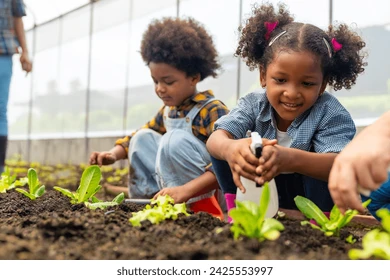
Across Nigeria, educators, agribusinesses, and government agencies are asking the same question: How do we make farming interesting to a generation raised on phones, games, and fast food?
The answer, they say, is to stop teaching agriculture like punishment and start selling it like an opportunity. With the average Nigerian farmer now over 50, getting kids interested is no longer optional. It is a food security strategy.
In some states, schools are partnering with agri-tech firms to set up hydroponics kits, aquaponics tanks, and smart greenhouses. Students use sensors and apps to monitor soil acidity and alkalinity, temperature, and growth. It feels like a science class, not manual labour, and when kids see data and gadgets, they pay attention.
This make them realise that agriculture is about biology, engineering, and business, and not just soil. Agriculture has to be made about money-making and business venture because kids respond to entrepreneurship.
School farm clubs should be run like small businesses where pupils plant vegetables, package them, brand them, and sell to parents during Parents Teachers Association (PTA) meetings, while profits go back into buying inputs. Some schools have agri-preneurs of the term awards to appreciate students, who did excellently during the planting period.
Experts say this teaches financial literacy early. “If a 10-year-old can see that N1,000 of seeds became N5,000 of pepper, they understand value chains”, an agronomist with the Nigeria Agricultural Land Development Authority (NALDA) noted.
Storytelling, cartoons, and social media should also be adopted because kids are also on YouTube and Instagram. Agricultural cartoon series and comics can be developed to teach about soil health and food safety in local languages. The goal is to make farmers look like heroes, not people, to pity.
Farm field trips should not feel like punishment.
Instead of just visiting a government farm, schools should take kids to modern facilities, fish farms with automated feeders, dairy plants that turn milk into yoghurt, and food processing factories. Seeing how raw cassava becomes packaged garri, or how tomatoes become paste makes the connection between farm and supermarket real.
Many kids would keep asking if they can have one of those machines at home. Competitions and gardens should reward creativity.
States and non-governmental organisations should launch young farmers’ competitions on who can grow the biggest pumpkin, the best sack garden, or design the smartest irrigation model from recycled bottles.
Urban schools with no land should adopt the use of vertical gardens and sack farming on rooftops. The message is: you don’t need 10 hectares to be a farmer!
Why it matters, now? Nigeria imports billions of dollars in food yearly while youth unemployment remains high. Agriculture offers jobs that can not be outsourced in processing, logistics, agritech, packaging, and export.
But for that to work, perception must change. “We have to stop telling kids agriculture is what you do when you fail (exam),” said a representative of the Federal Ministry of Agriculture of Food Security.
Moving ahead, parents, teachers, and policymakers should agree that the future of food will be decided by what today’s 8-year-olds think about farming. If agriculture is presented as innovative, profitable, and tech-driven, kids won’t run from it. They will run to it with phones in one hand and seedlings in the other. For Nigeria, that could be the biggest crop of all!
 Active journalism costs huge sums of money. To ensure quality and rich agricultural journalism, the support of readers and friends of the publication is required. Donations can be made in Nigerian Naira (NGN). Kindly provide relevant information during transactions and be assured that funds received will be used judiciously and appropriately. For donation to FarmingFarmersFarms, kindly click the link below, call or send message to: +2348095451987.