
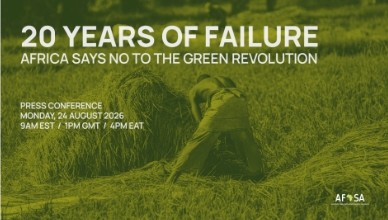
As AGRA, formerly known as Alliance for a Green Revolution in Africa,
marks its 20th anniversary with a continent-wide celebration tour, new evidence
has allegedly tells a different story that hunger has risen sharply across
AGRA’s focus countries since 2006, even as billions of philanthropic dollars
poured into the industrial agricultural model.
The Alliance for Food Sovereignty in Africa (AFSA)’s General
Coordinator, Million Belay and Tufts University researcher, Timothy Wise would
present two new reports that show the extent to which Gates-funded model of
agriculture devastated the continent., saying food sovereignty movement leaders
would ground the findings in their lived realities, as well as showing us what
alternatives are already taking root, led by farmers and activists. These, and
more, would be discussed during the forthcoming webinar, which takes place on
August 24, 2026 at 2pm West Africa Time (WAT), to be moderated by an
award-winning author, filmmaker and academic, Raj Patel.
Two new reports by AFSA and an independent researcher at Tufts
University point to 20 years of failed Green Revolution by Gates-funded AGRA,
and showcase farmers, who are already charting a different path. Key findings
of the reports also reveal that the “number of undernourished people across
AGRA countries has risen 58% since 2006. This is nearly double the 31% increase
found in an earlier 2020 assessment of the same countries, even as AGRA set a
goal of cutting hunger in half; and staple crop yield growth has slowed since
AGRA’s launch compared to the 12 years before it began, despite fertiliser use
more than doubling across the region.
Furthermore, “much of the increase in food production came not from
higher yields, but from clearing new farmland – cropland expanded 46% since
2006 – undermining the ‘sustainable intensification’ the model promised to
deliver; and Senegal, which was never an AGRA focused country, achieved the
very target AGRA set for its own countries: cutting hunger in half over the
same period. After billions poured into AGRA-aligned policies, farmers have
only grown hungrier and more in debt”, said the National Coordinator of the
Zambia Alliance for Agroecology and Biodiversity (ZAAB), Mutinta Nketani,
describing the situation in Zambia, saying “We cannot continue this way”.
“The agroecological alternative isn’t theoretical. Farmers are already
building the agroecological alternative: restoring soils, protecting their
seeds, diversifying their farms and reducing dependence on expensive external
inputs”, says the General Coordinator of AFSA, Million Belay. “It’s time to
fund what works”, it added. Wise’s assessment, “Requiem for Africa’s Green
Revolution”, was published on August 17, 2026 while AFSA’s report, “The Green
Revolution Has Failed Africa: Twenty Years of Evidence and What Works Instead”,
is to be released on August 24, 2026.
Speakers during the webinar would include a Senior Research Fellow at
Tufts University’s Global Development and Environment Institute and author of
the book “Eating Tomorrow”, Timothy Wise; the General Coordinator of AFSA and a
member of the International Panel of Experts on Sustainable Food Systems
(IPES-Food), Million Belay; a farmer and women’s rights activist from Niaguis
in southern Senegal, the Chair of the Pan-African movement, Nous Sommes la
Solution (We are the Solution), which operates across seven West African
countries, Mariama Sonko; as well as the National Coordinator of the Zambia
Alliance for Agroecology and Biodiversity (ZAAB), and Chair of the Seed and
Knowledge Initiative (SKI), Mutinta Nketani.
Lead researcher and community leaders would present the reports’
findings, and ground them in the lived realities of what two decades of Green
Revolution model had meant for farmers and consumers, as well as what
alternatives are already taking root on ground. AFSA is Africa’s largest civil
society movement, bringing together farmers, pastoralists, fishers, indigenous,
faith groups, women’s movements, youths, and consumer associations in a united
voice for food sovereignty on the continent. It is a network of networks
operating in 50 African countries, reaching 200 million people. Meanwhile,
journalists interested in covering the story can reach out to: kirubel.tadele@afsafrica.org, or hyojin@agrowingculture.org, the statement added.
 Active journalism costs huge sums of money. To ensure quality and rich agricultural journalism, the support of readers and friends of the publication is required. Donations can be made in Nigerian Naira (NGN). Kindly provide relevant information during transactions and be assured that funds received will be used judiciously and appropriately. For donation to FarmingFarmersFarms, kindly click the link below, call or send message to: +2348095451987.