



The Federal Government, in partnership with China, is planning a US$900 million investment in large-scale poultry projects aimed at producing up to six million eggs daily, as part of efforts to tackle Nigeria’s protein deficit and strengthen food security.
The Director-General and Global Liaison for the Nigeria–China Strategic Partnership, Joseph Tegbe disclosed this in an interview in Abuja, explaining that the initiative represents a shift in the bilateral relationship from infrastructure-focused cooperation to deeper development partnerships anchored on agriculture, industrial production, and technology transfer.
According to Tegbe, the plan involves the establishment of six integrated poultry farms across Nigeria’s six geopolitical zones, each designed to produce one million eggs daily. “We’re going to have six poultry projects across Nigeria to address food security issues. Oyo, Kaduna will be the pilots, and then we will do the four after. Each of those poultry farms is supposed to produce one million eggs a day. That means the two will produce two million eggs a day.
“By the time we have six million eggs a day, each one is supposed to have one million laying hens and 300,000 broilers. Each one of those poultry farms is supposed to have its power-generating plant. It’s supposed to have its abattoir, have its hatchery. Each of those poultry farms has backward integration. Because we do not want to set up a poultry farm and go out and import feedstock”, he said.
According to him, the pilot projects will be located in Oyo State in the Southwest and Kaduna State in the Northwest, with construction expected to begin soon after final approvals. Each facility will operate as a fully integrated agricultural complex with about one million laying hens and 300,000 broilers, supported by hatcheries, abattoirs, power generation plants, and feed processing facilities.
Tegbe explained that each poultry project will also be supported by about 10,000 hectares of farmland dedicated to cultivating maize and soybeans used in feed production, a strategy designed to reduce the high cost of poultry feed, which currently accounts for about 80% of production costs. “Each poultry farm will have 10,000 hectares of land. Cultivated to produce soyabeans and maize. Hence, we will produce the feedstock. If you ask the poultry farmers today, 80% of the cost is feedstock. If you crash the price of feedstock today, you will crash the price”, he said.
He added that each of the integrated poultry farms is expected to require about US$150 million in investment, covering land cultivation, irrigation systems, feed processing facilities, poultry housing, and supporting infrastructure. While the first two pilot projects will be fully financed by the Nigerian government, Tegbe said the remaining four farms will be funded through a partnership arrangement with Chinese investors.
Under the arrangement, China will provide 85% of the financing for the remaining projects, while Nigeria will contribute 15% as counterpart funding. “So it’s all together, about US$150 million. The first two we are financing is a pilot. Let’s do it. Let’s test it. Let’s see how it goes. The next four, fully funded by the government. Now, the other four will cost about US$656 million. The Chinese are bringing that fund for us. And it will be on an 85-15 counterpart funding basis. So out of that 656, Chinese will bring 85%. We’ll just do counterpart funding of 15%”, Tegbe explained. The funding will come with a 10-year repayment structure and a three-year moratorium.
Tegbe added that the projects are designed to operate on a commercial basis and are expected to repay their investment within three and a half years of operation. “Because our projection is in three and a half years, each of those poultry farms will pay back the money. So, I expect that in three and a half years, each of those poultry farms will pay the Federal Government their money. So, the Federal Government will take money back, still own its shares, and then, when we evaluate in five years’ time, Federal Government shares will have been doubled.
“Then they offload it. You and I can buy into the shares and as we are doing it from day one, one of the things we are going to do is also start to, in each of those regions, start to evaluate existing poultry farmers that will accept to be trained, that will accept to be exposed to new technology, to bid to manage those poultry farms”, he said.
He noted that reducing feed costs could significantly lower egg prices, making protein more affordable for low-income households. On average, eggs sell for between N250 and N300 across Nigeria, making them increasingly unaffordable for many families. Tegbe illustrated the challenge using the example of a worker earning N150,000 monthly, who would need nearly N50,000 a month just to provide one egg per day for a household of six. “That means a significant portion of income goes into just buying eggs, without even talking about other food items like rice, garri, or bread”, he said.
Beyond increasing protein supply, the initiative also aims to stimulate local agriculture by supplying excess feedstock to smaller poultry farmers at subsidised prices. According to Tegbe, about 50% of the feedstock produced at the integrated farms will be made available to other poultry farmers to help reduce their operating costs.
“So, in the first phase, we are funding fully. So, we say, come on, and ramp it up. The intention is that, once, we take advantage of the dry season to start the construction work. But after that, the next phase, which is the counterpart funding basis, Chinese bring in funding. And this funding they are bringing in is for 10 years, three years moratorium, you understand.

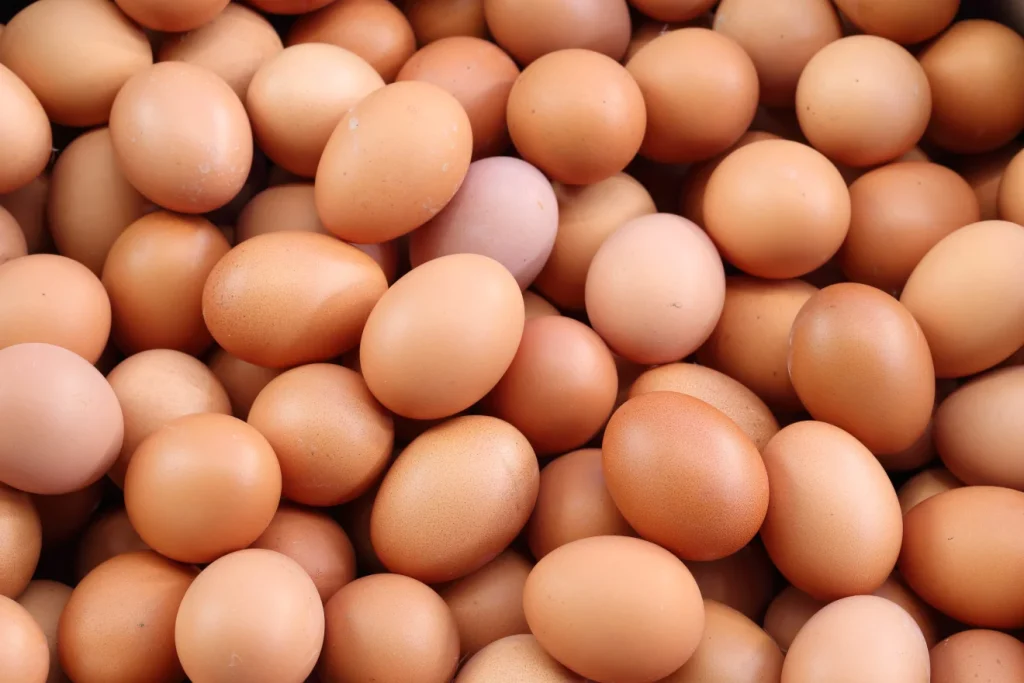
“We’ve run the numbers. The intention is to run this. We will run and will produce and sell the eggs at an extremely competitive price. At the same time, we will run those poultry in a business-like manner. “If you crash the price of feedstock today, you will crash the price of eggs. That will benefit the entire poultry industry”, he noted.
The poultry complexes will also incorporate modern production technology and temperature-controlled environments similar to large-scale farms in China. Tegbe said some Federal Government officials recently visited a poultry facility in Beijing capable of producing about 2.5 million eggs daily, which served as a model for the planned projects.
The farms are expected to begin production within six to eight months of construction, meaning eggs from the first pilot facilities could enter the market before the end of the year. “If you start up the construction work in March, and you put off your sheds in three months, and you put in your day-old chicks in there, in three months, you are having eggs flowing. So, our projection is six to eight months. So, you start in March, we’re talking about September. Come December, people will be eating President Bola Tinubu’s eggs in this country, and it’s coming from those two poultry farms”, Tegbe said.
He explained that in the long term, the government plans to transfer management of the facilities to Nigerian private sector operators and eventually list the projects on the Nigerian Stock Exchange so that citizens can acquire equity stakes.
The approach, Tegbe noted, mirrors China’s development model, where the government initiates large-scale projects before handing them over to private investors for long-term sustainability. “Sometimes the government leads the way to create the framework, and then the private sector takes over and runs it sustainably. So, the intention is that you get Nigerian companies to take it over”, he added.