
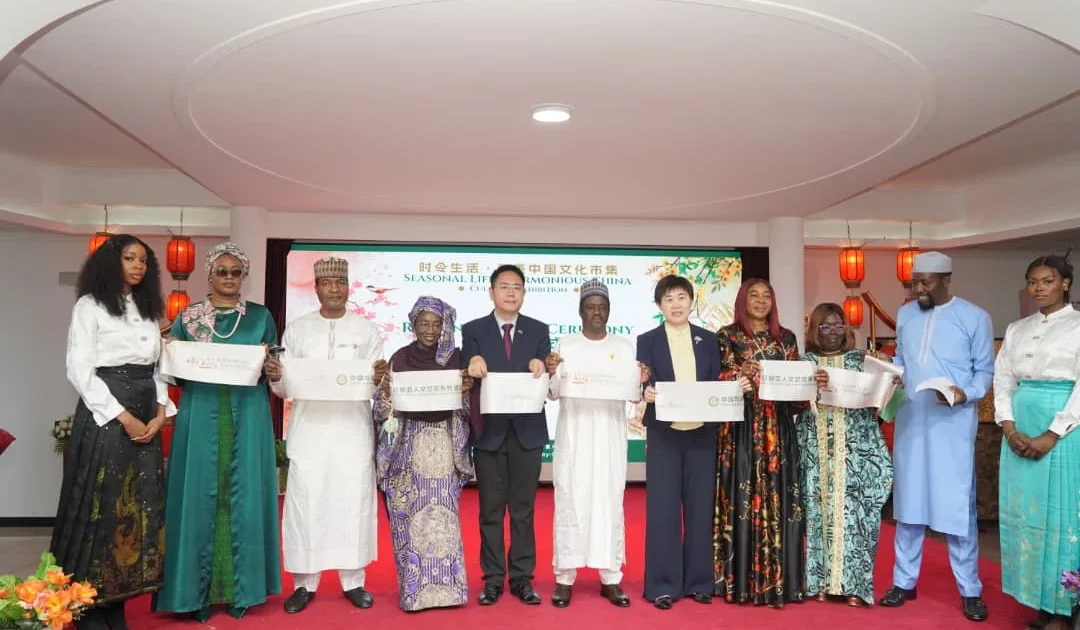
The Federal Government has announced plans to deepen scientific and technological collaboration with China to reduce post-harvest losses, promote agro-processing, and boost Nigeria’s agricultural exports.
The Permanent Secretary, Federal Ministry of Innovation, Science and Technology, (FMIST) Dr. Mukhtar Muhammed disclosed this in Abuja at the Seasonal Life and Harmonious China Cultural Exhibition, held at the China Cultural Centre.
Muhammed said the collaboration would focus on practical areas, including the development of affordable solar-powered cold storage facilities, technology transfer for agro-processing, and expanded scientific exchanges between Nigeria and Chinese institutions.
He said Nigeria must leverage the recent expansion of access to the Chinese market to move beyond the export of raw agricultural commodities.
“To meet the strict quality, packaging, and supply chain standards required by the Chinese market, we must deepen our scientific innovation. This is where the FMIST plays a pivotal role”, he said.
According to him, the transformation of Nigeria’s agricultural sector hinges on scientific innovation, adding that his recent technical visit to China had reinforced the ministry’s resolve to strengthen cooperation between the two countries’ science and technology ministries, higher institutions and industries.
He said, “We intend to partner with Chinese research institutes to develop affordable, solar-powered cold storage facilities for perishable goods”.
On agro-processing, Muhammed said Nigeria would seek technology transfer to process cassava, shea butter, and cashew nuts into finished products for the Chinese and global markets. “We want to move from exporting raw commodities to exporting value-added products“, he said.
The Permanent Secretary also announced plans to expand scholarships and Science, Technology, Engineering, and Mathematics (STEM) training for Nigerian scientists in Chinese universities, particularly in sustainable agriculture and water management.
Muhammed said his recent visit to the Yangling High-tech Agricultural Demonstration Zone in the Shaanxi Province, exposed the Nigerian delegation to the application of technology in improving agricultural productivity and conserving water.
He said the experience offered valuable lessons for addressing agricultural challenges in Northern Nigeria and the Lake Chad region. “In Yangling, often referred to as China’s ‘Agricultural Silicon Valley,’ we witnessed the seamless integration of modern technology with traditional farming.
“For example, we observed advanced water-saving irrigation systems and soil monitoring technologies that allow farmers to cultivate crops in arid conditions with minimal water wastage”, he said.
He described the Chinese experience in combating land degradation and improving agricultural productivity in the Loess Plateau, as a powerful inspiration for Nigeria.
Muhammed also said the China-Nigeria relationship is entering a season of unprecedented opportunity, particularly with the growing emphasis on agricultural, technological, and scientific cooperation.
He said the Federal Ministry of Innovation, Science and Technology is committed to ensuring that increased trade opportunities were matched with scientific and technological advancement. “The Federal Ministry of Innovation, Science and Technology is committed to ensuring that this new season of trade openness is matched by a new season of scientific enlightenment and technological advancement”, he said.
Speaking at the event, the China Cultural Centre Counsellor, Yang Jianxing, said cultural exchanges remained an important component of China-Africa cooperation and a bridge for strengthening mutual understanding between the peoples of China and Nigeria.
 Active journalism costs huge sums of money. To ensure quality and rich agricultural journalism, the support of readers and friends of the publication is required. Donations can be made in Nigerian Naira (NGN). Kindly provide relevant information during transactions and be assured that funds received will be used judiciously and appropriately. For donation to FarmingFarmersFarms, kindly click the link below, call or send message to: +2348095451987.